
Four Defaults Schools Should Question
It’s not just tech that comes with settings someone else chose for us.

In her 2023 book Unmasking AI, Joy Buolamwini warns us that the default settings of any technology are not neutral. Default settings “often reflect the coded gaze… the machines we build reflect the priorities, preferences, and even prejudices of those who have the power to shape technology.”
I often bring up default settings in my AI workshops with educators and students. Defaults are pre-set elements that reflect how the technology’s designer wants us to use the tool. Look at the complex, non-neutral technologies we use regularly like smartphones, social media, or generative AI chatbots. The colorful, intuitive touchscreen of a smartphone; the constant notifications and seductive algorithmic feeds of social media; and the conversational, confident, and sycophantic “voice” of a chatbot are all elements built into these technologies to keep us engaged.
Because these settings are the default, we tend to see them as fixed. Designers use defaults to exploit the cognitive bias of anchoring, where humans set expectations and make decisions based on the first piece of information presented. Defaults are easy to accept and hard to change. There’s a reason it’s called “anchoring”: our first impressions are heavy and hard to move. Changing default settings takes work.
Recognizing defaults as choices made for us by someone else is the first step towards changing our relationship with defaults. We can manipulate the interface of our smartphones (or choose “dumber” phones), we can limit or curate or silence our social media feeds, and we can prompt chatbots out of their chatty validation habits. The more I have learned about my phone, my social media, and my AI chatbots, the more my use has become intentional, moderate, and focused.
Thinking about the default settings of generative AI tools has led me to think about the default settings of school, especially in the age of AI. Schools also have some pre-set design elements that we have come to view as immutable. Yet, the arrival of generative AI has revealed that some of these defaults are worth questioning, especially if we are interested in nurturing agency in both our colleagues and our students as they navigate an increasingly AI-infused world.
Devices First → Devices as Needed
We Decide for Students → We Teach Students How to Decide
Student Use Policy → Community Use Policy
AI is EdTech → AI is Infrastructure
1. Devices First → Devices as Needed
Using AI chatbots has become a default behavior of many young people, just as previous generations defaulted to Googling things. I have heard from so many students about using an AI chatbot to answer questions a teacher asks in class, or uploading photos of what’s on the board or on a worksheet for the chatbot to explain or solve, or having an AI agent listen and take notes, or deploying an agentic browser to complete some online activities. These moves are easy to make in “device first” classrooms, where the default is to sit down and open a laptop or a tablet.
But if the device is not needed for the work of the class, why is the default for all of us to have our devices open? Our awareness of AI and the ways in which student use can bypass thinking should lead us to question the default setting of device-first classrooms.
I believe deeply that students should be skilled enough to be able to use any technology they want in service of discovery, growth, and creation. However, we know enough about the attentional issues internet-connected devices cause for us to recognize that “devices open” is a problematic default setting when students’ attention is meant to be directed elsewhere. When a teacher is spending more time asking students to close devices than to open them, it’s worth thinking about the relationship between the technology, the teaching, and the intended learning.
Beginning a class with a conversation or with some quiet writing in journals or with group work at the board are all device-free, AI-resistant learning strategies. They are also hard to manage if every student is also on an internet-connected device.
At the same time, asking students to use a technology like generative AI to explain/critique ideas or to find/organize information or to design a creative solution to a problem are all device-driven, AI-forward learning strategies. They are also hard to manage if not all students have access to an internet-connected device or not all students know how to use relevant tools well.
In the age of AI, we’re going to have to strike a more transparent, intentional balance between analog and digital learning activities. Both teachers and students should have access to high-quality tools (digital or otherwise) and both teachers and students should be knowledgeable about when and how to use those tools. Simply defaulting to devices first or no devices at all does nothing to build that knowledge.
2. We Decide for Students → We Teach Students How to Decide
We should not treat the decision to allow or restrict technology as equivalent to teaching students how to use it. Teaching them about technology helps them see, then question, the default settings of the technology. Teaching them about technology helps them see and manage technology’s role in their personal and academic growth.
Let’s say you move from a “Devices First” default to a “Devices as Needed” default in classrooms. Once the teacher decides the device is needed and the student opens it, a cascade of decisions then falls on the student. Where should I look? What should I open or not? Can I connect what is happening on my screen to what is happening in class? Am I improving/discovering/making interesting choices or am I distracted/forgetting the goal? Should I move away from technology for a moment to think or write? Can I look at the output and explain its meaning and its value? Can I name alternative pathways to arriving at the goal?
We should be empowering students to answer these questions for themselves. This is especially important when it comes to generative AI, where unpredictability and versatility are both its superpower and its risk. As Nick Potkalitsky writes, we don’t want AI literacy to be “compliance in sheep’s clothing”, where we hand students a checklist of rules. We want a student to know how to spot a technology like generative AI, understand what the tech can do, make a choice about use, and reflect on the impact of that choice. I like the three skills veteran teacher Stephen Fitzpatrick will be prioritizing with his students this coming year: planning, precision, and patience.
3. Student Use Policy → Community Use Policy
I have read dozens of AI policies, and with very few exceptions they are about student behavior. “Students should only use AI when…” and “Students are responsible for…” and “Students may not…”
I am all for personal accountability when it comes to academic integrity, but policies that put the onus of responsible AI use solely on the student are missing the myriad external factors that affect student use. Our guidelines should address the systems we have designed, not just the students we require to participate in those systems.
First, our AI guidelines should engage with the ways our assessments do and do not meet this AI moment. I have shared Leon Furze’s “Five Guiding Principles for Rethinking Assessment with GenAI” before, and it remains one of the clearest articulations of the capacity that educators need in order to respond to AI’s impact on the validity of their assessments.
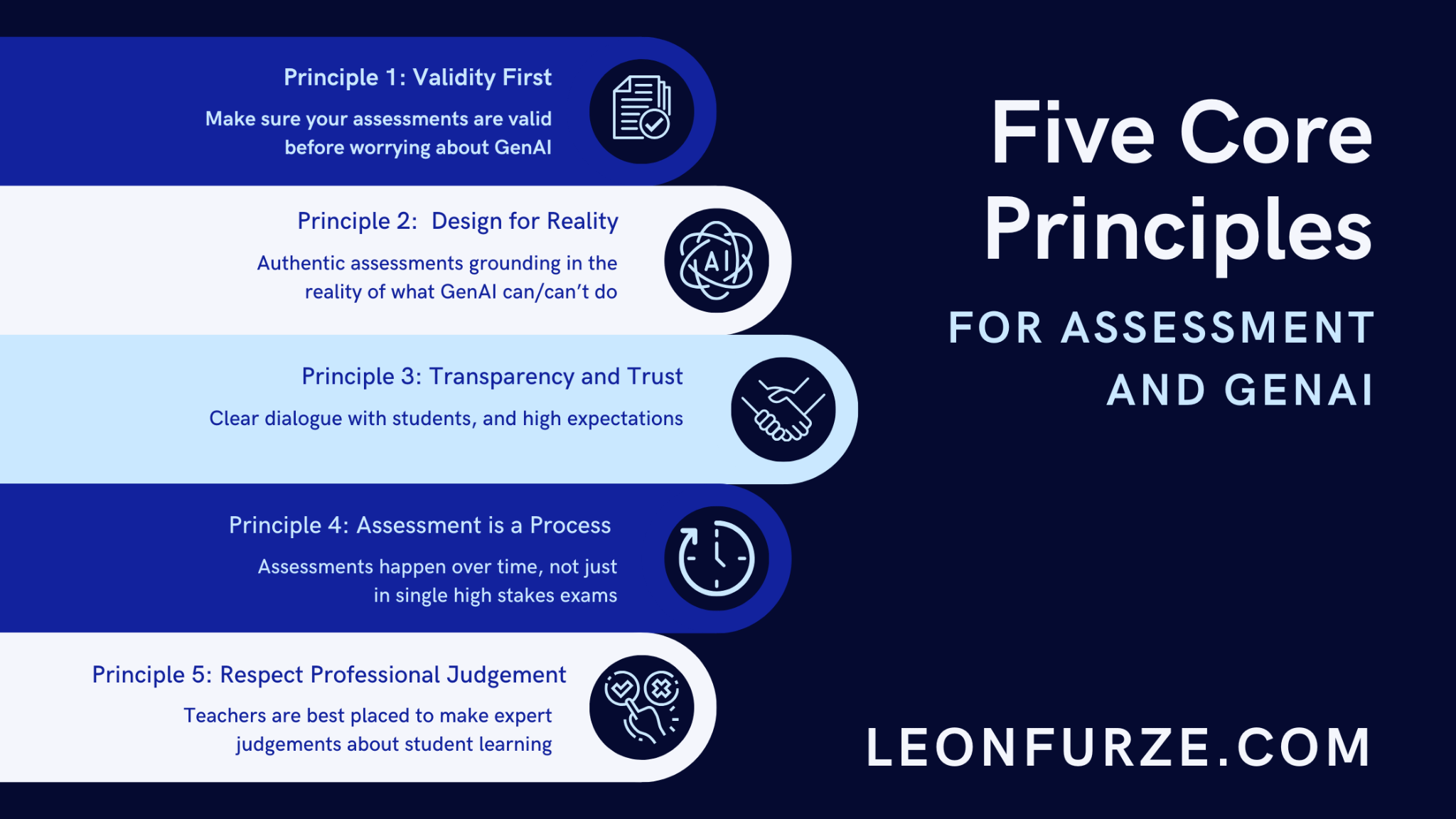
Schools should be insisting on new modes of assessment as a key part of any AI strategy. Schools also should be looking at grading policies and homework policies and academic integrity policies through the lens of generative AI. Which behaviors are we explicitly requiring and implicitly incentivizing? How might our actions be contributing to inappropriate student use? How might our policies be restricting students from taking advantage of the power this technology offers?
Second, our AI policies should set expectations about AI use by teachers in the classroom. This study found providing a teacher a chatbot to assist with the work of teaching led students to find the class less interesting and to achieve at a lower level. As the study’s authors make clear, this is not an indictment of AI use; rather, it is a reminder that using technology without human expertise and discernment is not just a problem when it comes to students. It can be a problem when it comes to adults.
Third, our AI guidelines should be clear about the way we talk with students about AI, which can have an impact on trust and motivation. Jenny Anderson and Allison Lee argue that using control, fear, shame, or the specter of punishment to manage student behavior with AI can often backfire, driving student use even more deeply into the shadows. And, as I’ve written about before, policies designed to micromanage behavior can become “trust substitutes” that signal we don’t have faith in others’ integrity, leading people to interpret our mistrust of them as a reason for them not to trust us.
Yokohama International School has articulated AI guidelines for students, teachers, administrators, and parents. You don’t need to agree with all of these guidelines to recognize there is power in transparently agreeing that the whole community will hold itself to certain standards around AI use.
4. AI is EdTech → AI is Infrastructure
Generative AI is not educational technology. Of course, there are tools powered by generative AI (MagicSchool, Flint, Playlab, etc.) designed for educational purposes, but they are platforms that harness generative AI for specific functions. They are not representative of the full capabilities of the technology. Saying an AI edtech tool is AI is sort of like saying a learning management system is the internet.
Treating AI as edtech narrows our understanding of its impact on the people in schools. The goal of the leading AI companies has always been to make generative AI infrastructure, to have it embedded in workflows and interactions to the point where it is invisible, where it becomes a default. We can look back at the internet and personal computers as better analogies for how to think about generative AI’s impact on our lives.
This has implications for education that extend far beyond integrating AI edtech tools into classrooms. Students are using AI outside of class to do their homework, to help them study, and to stay organized. Adults in schools are using AI to communicate with students and families, to draft feedback, and to create teaching materials. Both adults and students are using AI for advice, coaching, and even companionship. Both adults and students are using AI for search and news and entertainment. No edtech tool adequately addresses the issues these uses raise.
We can manage the integration of educational technology through procurement processes and well-organized rollouts. Schools who want to see AI edtech integrated into classrooms should rely on these structured systems to vet tools appropriately. But, this is a tempting place to over-focus because it gives us a sense of control. But generative AI, as Justin Reich and Jesse Dukes write, is an “arrival technology,” a technology that seems to “fall from the sky” and thus cannot be slowed or reined in by the same processes we use to control edtech.
When we see AI as infrastructure, we can see the breadth and depth of its impact more clearly. We can interrogate school design elements that are ripe for adaptation in the face of AI, like homework and certain assessment practices. We can explore elements that can benefit from AI’s capabilities, like executive functioning and data analysis. And, we can decide to fight for and protect the elements that are vulnerable, like teacher-student relationships and motivation. This holistic approach moves us past a “yes or no” adoption strategy and towards an engagement strategy: How do we make sense of this change and how do we use that knowledge to deploy AI strategically?

Make Defaults Visible So We Can Talk About Them
The rapid, widespread, and deepening adoption of generative AI by so many of our students and colleagues reveals 1) this technology is not going anywhere, even if the form it takes changes, and 2) it is changing the way people in schools go about their work. Holding on to defaults simply because they are the norm is not an effective response to this change.
Making defaults visible to that we can question them is important work. From there we can plan what we want to protect, adapt, and transform. The work required to manage the complexity of this disruption is intimidating, but I think it is worth our effort.
I’ll end by offering Edutopia’s suggested agenda for a “tech summit” to host at your school. The topics covered capture many of the default settings in school that we need to discuss. Importantly, the deliverable is not policy documents or suggested tools. The deliverable is increased clarity about where we are and where we would like to go from here.
Upcoming Ways to Connect With Me
Speaking, Facilitation, and Consultation
If you want to learn more about my work with schools and nonprofits, take a look at my website and reach out for a conversation. I’d love to hear about what you’re working on.
Online Workshops
September 23, 2026 - February 24, 2027. Kawai Lai and I will be facilitating a second run of “Leading from the Middle: Managing Up, Down, and Across,” a five-session virtual program. Designed for department chairs, deans, and others in middle leadership, the program offers practical, human-centered ways to support those we supervise and those who supervise us. Offered in partnership with the California Teacher Development Collaborative.
The Toddle “100”
I am on a review panel gathered by Toddle to recognize 100 innovative educators in independent schools. Specifically, we’re looking for nominees that are doing impactful work in Curriculum Innovation, AI and Emerging Technology, and Leadership and Systems Change. I hope you’ll consider applying or nominating an innovative educator you know. To learn more, you can listen to this conversation I had with fellow panelists Jay McTighe and Denise Pope, moderated by Toddle’s Cindy Blackburn.
Links!
If you are an AI-curious educator, this update from Ethan Mollick on the current state of generative AI is essential reading.
We should be paying attention to AI developments in China, whose models are very good, have been rapidly adopted globally, and are increasingly popular among users in North America. China is also moving more quickly than the U.S. in regulating AI companions.
Jon Ippolito, who has been tracking the environmental impact of generative AI for a few years now, has a two-part series called “What if data centers aren’t really about AI?”
More on data centers: 1) Sasha Luccioni on “How to Make Data Centers More Sustainable” and 2) a great overview of the problem of powering data centers.
An updated study (June 2026) on the efficacy of AI detection tools.
On a related note, Substack has partnered with the AI detection company Pangram, so you can now scan posts (including this one!) for AI-generated content. Tim Requarth has a thoughtful piece on what improvements in AI detection technology do and do not change about how we should use it.
I was not familiar with the work of math educator Henri Picciotto but now I am convinced his ingeniously simple lessons hold a key for teaching in an AI age. Start with this great overview then follow the links to explore his work.
I am writing this as my husband deals with a wonky refrigerator and tries to reset it to the factory settings. Default settings are clearly the theme of the morning!
I love the idea that AI developers may create the “factory settings,” but schools have the most power over how these tools are used. Educators/districts can, and should, adjust the "settings" by providing clear direction, context, and expectations that reflect their communities' values.
Love your 4 questions Eric and 100% agree!! Have you read Abi Awomosu's work?